Kim Schneiderman
Psychotherapist, Author, Columnist, Writing Workshops

  • Home
  • Professional Services
    • Psychotherapy
    • Writing Workshops
    • Speaking Engagements
  • The Book
  • Media
    • Columns
    • Blog
    • Interviews
    • Articles & Essays
    • In the News
  • Courses and Events
  • Kim’s Story
  • Contact

What to Say When You’re Not OK

Once Upon a Couch

Question: This spring, I will be getting divorced. Because everyone is in such good spirits, I feel like I have to pretend that I’m OK, but I’m devastated. When people ask how I am, I never know how much to share.

When you’re in crisis, a simple “How are you?” can feel like the prelude to a hug or a punch in the gut, depending on who’s asking and when/where the question is being asked. From a trusted friend, it can feel like a much-welcomed invitation to unburden your heart. But from a colleague or acquaintance, it can serve as a reminder that you’re not OK as you find yourself fighting back emotions.

Sometimes, keeping up appearances is necessary and unavoidable, particularly in professional situations. But pretending can also be exhausting, especially when your emotional resources are already taxed. It also perpetuates the idea that it’s somehow shameful to be sad, even though your feelings are completely understandable. Read more…

http://www.metro.us/kim-schneiderman/what-to-say-when-you-re-not-okay/zsJoer—jeG7zrduhJnM/
Filed Under: Columns

Comments

  1. Andre says

    July 29, 2015 at 3:56 am

    {Thanks for a marvelous poisntg! I really enjoyed reading it, you happen to be a great author.I will be sure to bookmark your blog and will eventually come back from now on. I want to encourage continue your great writing, have a nice morning!|My partner and I absolutely love your blog and find almost all of your post’s to be just what I’m looking for. Does one offer guest writers to write content for you personally? I wouldn’t mind composing a post or elaborating on a few of the subjects you write with regards to here. Again, awesome site!|We stumbled over here by a different web page and thought I should check things out. I like what I see so now i am following you. Look forward to checking out your web page again.|I really like what you guys are up too. This kind of clever work and reporting! Keep up the amazing works guys I’ve incorporated you guys to blogroll.|Good day I am so excited I found your blog, I really found you by accident, while I was looking on Bing for something else, Anyways I am here now and would just like to say thanks a lot for a incredible post and a all round exciting blog (I also love the theme/design), I don’t have time to read through it all at the minute but I have saved it and also added in your RSS feeds, so when I have time I will be back to read much more, Please do keep up the fantastic work.|Admiring the time and energy you put into your website and detailed information you present. It’s awesome to come across a blog every once in a while that isn’t the same old rehashed material. Fantastic read! I’ve saved your site and I’m adding your RSS feeds to my Google account.|Hi! I’ve been reading your blog for a long time now and finally got the courage to go ahead and give you a shout out from Porter Texas! Just wanted to mention keep up the great work!

    Reply
  2. my blog says

    September 8, 2015 at 1:02 am

    Great post. I’m experiencing some of these issues as well..

    Reply
  3. why not look here says

    September 9, 2015 at 5:45 am

    Greetings! Very useful advice within this post! It is the little changes that make the most significant changes. Thanks a lot for sharing!

    Reply
  4. Ann Miggo says

    January 24, 2016 at 10:04 pm

    Great post. Thanks for the read.

    Reply
  5. Noreen Langon says

    January 26, 2016 at 9:52 am

    Good article, thanks.

    Reply
  6. Johana Clenney says

    January 27, 2016 at 11:35 am

    Great post. Thanks for the read.

    Reply

Leave a Reply Cancel reply

Your email address will not be published. Required fields are marked *

Other Offerings


Step Out of Your Breast Cancer Story

A Journey of Healing, Meaning, and Renewal

Every life is an unfolding story — a sacred, ever-evolving narrative that only we can interpret. For breast cancer survivors, one of the greatest challenges is making sense of the profound physical, emotional, and spiritual changes that accompany diagnosis, treatment, and recovery. How we understand and tell our story shapes how we feel about it — and can even influence how it continues to unfold.

Offered in partnership with the Northern Dutchess Hospital Survivorship Program, this 4-week group provides a supportive space for breast cancer survivors to reflect, share, and rediscover their personal story as one of courage, growth, and transformation.

Together, we’ll explore how the difficult chapters of our lives can reveal hidden strengths, wisdom, and renewed purpose. Through guided reflection, group connection, and gentle journaling prompts (optional), participants will begin to integrate the challenges and insights of survivorship — and envision the next chapter of their lives with clarity and compassion.

Program Highlights

Participants will:

  • Reframe painful or self-limiting stories into narratives that honor resilience, grief, and growth.
  • Discover inner resources and voices of courage, wisdom, and self-compassion.
  • Integrate the emotional and spiritual lessons of survivorship in community with others who “get it.”
  • Reclaim authorship of their story and identity beyond “breast cancer survivor.”
  • Envision a thriving future self and a life grounded in meaning.

Presented in collaboration with the Northern Dutchess Hospital Survivorship Program as part of the hospital’s Light the Village Pink initiative for Breast Cancer Awareness Month.

(Dates and registration details coming soon — sign up below to receive updates.)


    Reframe Your Narrative About Challenging Relationships

    A 10-week Online Course with DailyOM

    Tired of people pushing your buttons? For as little as $19, you can liberate yourself from self-defeating patterns around people who trigger you. Register here to receive 10 weekly insights, writing exercises, and guided meditations you can access whenever you want.

    Lesson 1:  Soul Narrative vs. Self-Defeating Story
    Lesson 2:  Exploring the Power of Choice and Voice
    Lesson 3:  Your Adversary as Your Personal Trainer
    Lesson 4:  Embracing Your Strengths and Superpowers
    Lesson 5:  Getting to Know Your Inner Antagonist(s)
    Lesson 6:  Dialoguing with the Parts that Get Triggered
    Lesson 7:  The Yoga of Character Development
    Lesson 8:  Supporting Characters, Tools and Resources
    Lesson 9:  Giving Ourselves the Blessing We Seek
    Lesson 10: The Golden Happy Ending


    A FULL HOUSE AT THE NYC BOOK SIGNING!

    11666175_10153509534099665_7556630144058564704_n
    IMG_2358
    11539252_722074054569793_8893902440045718527_o (1)
    IMG_2381

    About The Author: Kim Schneiderman

    Psychotherapist and freelance journalist Kim Schneiderman utilizes research-based methods to help people who are stuck – in a dead-end job, relationship, of life stage – imagine themselves as the star of their own stories with the power to reclaim their personal narratives. Drawing on the elements of a story that many of us learned in high school (premise, scene, plot, conflict, climax, resolution), readers will assign titles to different chapters of their lives, observe recurring themes, identify supporting characters, and explore how conflict creates opportunities for personal growth that can lead to a meaningful resolution. They will also be asked to examine how the decisions we make, both big and small, affect our storyline – the relationships we choose, how we spend our day, and how we nourish ourselves, physically, mentally, emotionally, and spiritually.

    Unlike most self-help writing workbooks, most of the exercises in Step Out of Your Story are framed in the third-person voice, freeing readers to see beyond their usual point of view. Psychological research suggests that people are more likely to view their lives favorably when they see themselves as characters in a story. In a 2005 Columbia University study reported in the Journal of Psychological Science, test subjects who spoke about difficult chapters in their lives in the third person narrative displayed more confidence and optimism than those who recalled bad memories in the first person. By retracing their steps from the perch of the third-person narrative, people were more likely to regard their problems as something outside themselves – challenges they had conquered or adversaries they had defeated - instead of character flaws. Additionally, the perception that they had overcome obstacles left them feeling more confident to face the future.

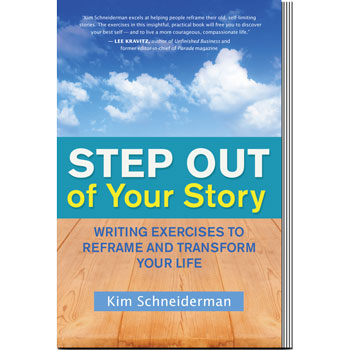
    Step Out Of Your Story

    STEP OUT OF YOUR STORY

    Writing Exercises to Reframe and Transform Your Life

    Every life is an unfolding story, and how individuals tell their story matters. Recent Stanford and Columbia University studies show that how we view the story of our life shapes the life itself. Who are the heroes and villains? Where does the plot twist? How are conflicts resolved? Learn more...

    Order Your Copy Today!

    New World Library Amazon Barnes & Noble


    © 2025 Kim Schneiderman, LCSW, MSW · All Rights Reserved · Website design by SimonAbramson.com